By Paul Perry, featuring Yuri Izrastzoff
When a Buenos Aires real estate broker tells me the city is "trendy" in the States, I push back. Not because Americans aren't coming — they are, in numbers I never saw in the 1990s — but because "trendy" implies a TikTok fad, and what's happening on the ground is weirder and more durable than that. If you're reading this, you're probably trying to figure out whether the move is a smart bet or just social media noise. Here's the unvarnished answer, from someone who landed here when the only other American in the city was a ghost.
The Trend That Isn't (Quite) a Trend
Yuri Izrastzoff, who's watched the Buenos Aires property market from the inside, sees an undeniable American wave. Census data backs some of that: the US-born population in Argentina grew more than 30% between the last two national counts, with roughly 60,000 Americans now estimated in the country. The US also leads in digital nomad visa requests. So yes, something is happening.
But "trendy in the US" is the wrong frame. Ask someone in Ohio what they think of Buenos Aires and you'll get a blank stare. What's actually accelerating is Buenos Aires among digital nomads. That's a global, English-speaking, laptop-class migration, not a mainstream American cultural moment. The distinction matters because it tells you who's arriving and what they're expecting.
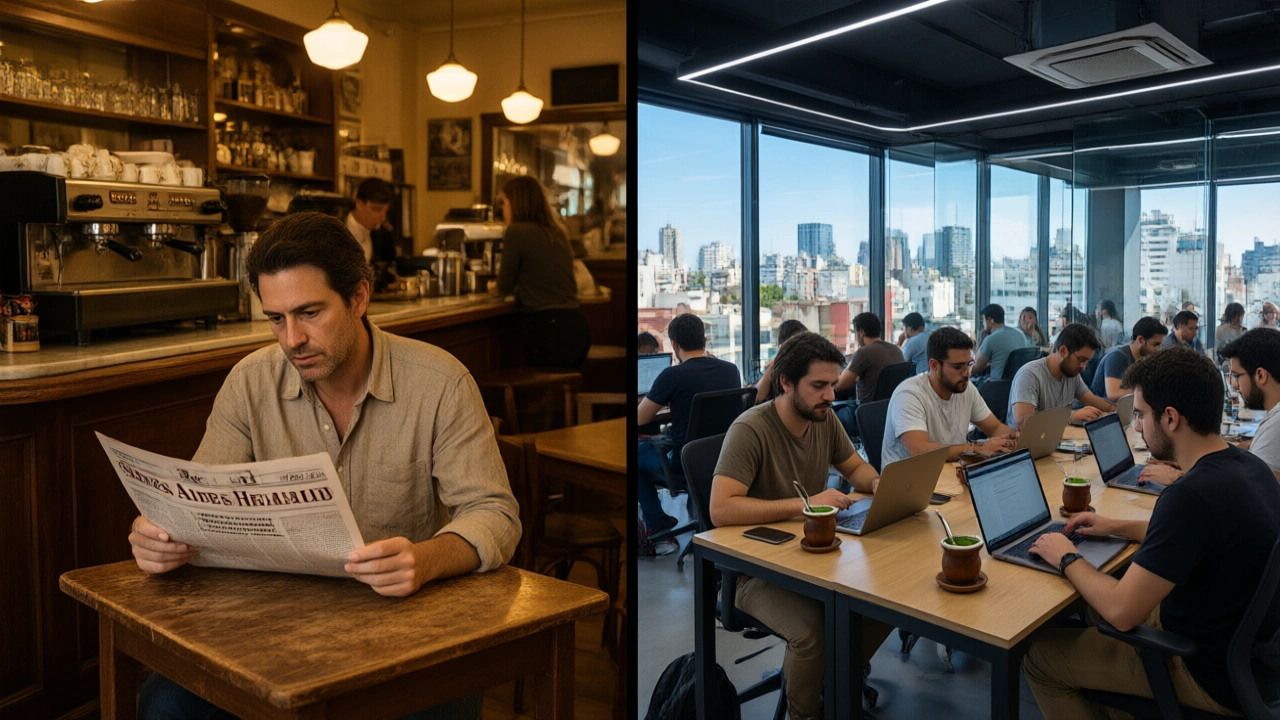
Who's Actually Coming (It's Not Who You Think)
When I got here in 1990, I didn't meet another American for eight months. I found work through the Buenos Aires Herald classifieds, lived in a flophouse in Real de Ayuda, and picked my fútbol team — Chaco Forever — because their red-and-black colors matched my Atlanta Falcons. (They told me, "No, it has to be forever." Chaco Forever. I never saw them play; they dropped to the B league and vanished.)
Today's arrivals are a different species. They fall into three rough profiles:
- The retiree with capital: Selling a 30-year mortgage in the States, buying a Recoleta apartment in cash with dollars. They're not slumming it; they're arbitraging real estate and cost of living.
- The young digital nomad (22–30): Often family-money funded, "messing around on their phone," as I put it to Yuri. They're in Palermo, they're in the co-working spaces, and some of them are serious — but plenty are treating Buenos Aires like a discounted playground.
- The self-made long-termer: The rarer breed. People who arrived with a skill, built something, and stayed because the city got under their skin. That's my category, and it's the one that tends to stick.
What's striking is the shift from "hippie on a shoestring" to "family with money." The people arriving now aren't backpackers. They're remote workers earning well, or retirees who've done the math. That changes the neighborhoods, the rental market, and the vibe.
Why Buenos Aires Wins the Infrastructure Game
If you're choosing between Latin American cities for remote work, Buenos Aires has a quiet advantage that doesn't show up in cost-of-living spreadsheets: the Wi-Fi actually works. I've spent time in Costa Rica, and the connectivity here is superior — more reliable, faster, and more widely available. For a digital nomad whose income depends on uninterrupted Zoom calls, that's not a luxury; it's the whole game.
Payment infrastructure is another silent win. Despite Argentina's capital controls, there are established digital currency and cryptocurrency channels that let remote workers collect USD income and convert it without getting strangled by the official exchange rate. You need to know the workarounds — and they shift with the regulatory winds — but the rails exist. As of August 2026, the brecha (gap between official and parallel exchange rates) remains significant, though Milei's "zero emission" monetary policy has introduced new volatility. Before you move a dollar, check a live tracker like dolarhoy.com or Ámbito Financiero.
And then there's the English bubble. In Palermo, you can move entirely in English — "te movés todo en inglés," as I told Yuri. Villa Crespo is rising fast as the spillover neighborhood. That linguistic ease isn't available in Bogotá or Lima to the same degree, and for someone who needs to hit the ground running, it's a genuine accelerant.
For a deeper look at the legal pathway that makes this possible, read our Argentina Digital Nomad Visa: Your 2026 Guide.
Where Americans Live (and Where They Don't)
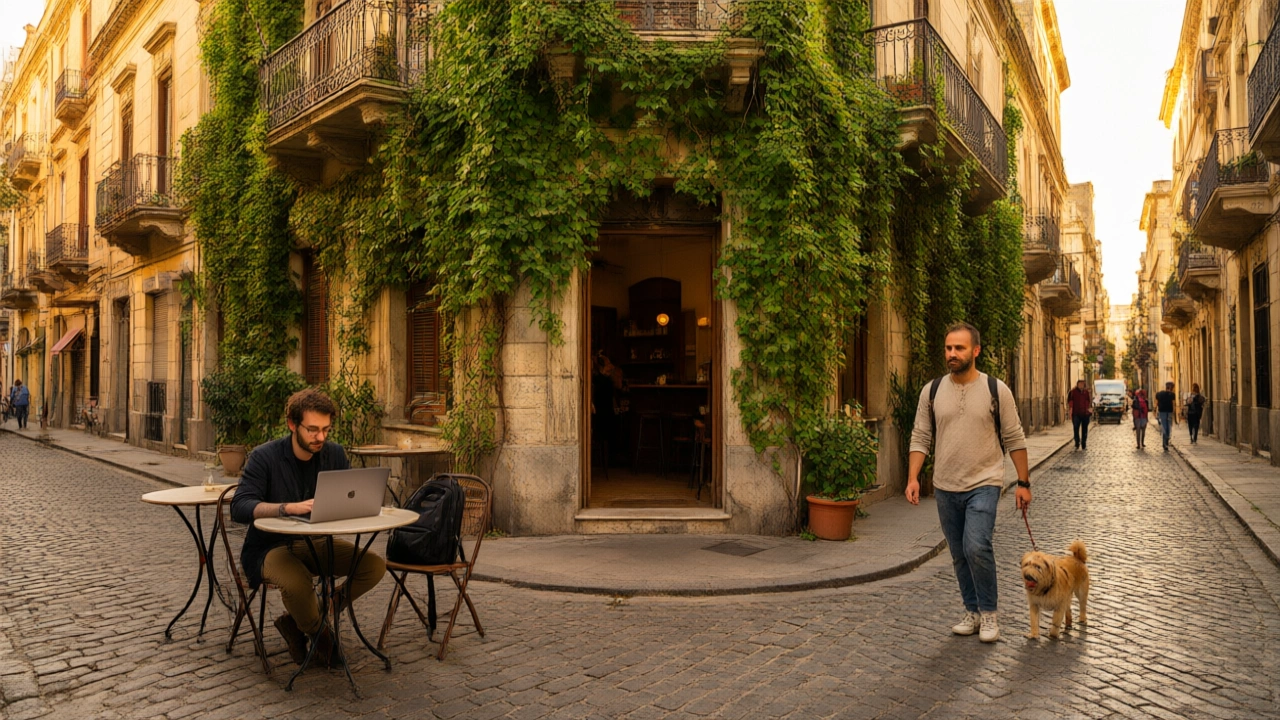
The geography of the American influx is surprisingly narrow. Palermo is the gravitational center — specifically Palermo Soho and Hollywood. Recoleta attracts the retiree crowd with its Parisian bones and established expat services. Villa Crespo is the next frontier, cheaper and grittier but rapidly gentrifying.
What's not trendy? Puerto Madero. "Muy moderno," I told Yuri — it's not what people come to Buenos Aires to find. They want the Belle Époque architecture, the café culture, the tango in the streets, not a waterfront of glass towers that could be anywhere. San Telmo, despite its postcard charm, hasn't fulfilled its promise as an expat hub; the infrastructure and safety perceptions lag behind the aesthetic.
The housing market has adapted to foreigners through a parallel system. Standard Argentine leases require a garantía — a property guarantor — that no newcomer can provide. So an entire temporary rental economy has emerged: Airbnb, specialized agencies, and direct owner arrangements that bypass the guarantor entirely. As of mid-2026, a furnished one-to-two-bedroom temporary rental in Palermo or Recoleta runs roughly $800–$1,500 USD per month. That's not cheap by Argentine standards, but it's the price of entry without local credit.
The Friction That Doesn't Make Instagram
For all the upside, Buenos Aires has a way of humbling you. The bureaucracy is legendary, and it's not charming when you're in it. Take the formulario 08 — the document required to buy a vehicle. It involves police verification, Spanish-only processing, and a multi-step dance that Americans find genuinely bewildering. There's no English help line, no streamlined digital portal, no apology for the queue. You either learn the system or you pay someone who has.
I've watched people import cars and lose $20,000 in the process. The lesson is consistent: Buenos Aires rewards those who arrive light, adapt fast, and don't try to impose American expectations on Argentine systems.
There's a cultural operating system at work here, and it's captured in three phrases every expat learns: No pasa nada (nothing happens / don't worry), está todo bien (it's all good), and se me complicó (it got complicated on me). These aren't just words; they're coping mechanisms. The city functions despite its absurdities because people have learned to absorb chaos without breaking stride. If you can't internalize "no pasa nada," Buenos Aires will eat you alive.
The Healthcare Shock (the Good Kind)
American arrivals consistently experience a psychological recalibration when they encounter the healthcare system. Emergency care in Argentina is free at the point of service — by law, for everyone, including tourists. I've seen it firsthand: my niece received full treatment in Tilcara, Salta, without paying a peso. My father had a three-day public hospital stay here at no cost.
For someone coming from the US, where a single ER visit can mean financial ruin, this is genuinely disorienting. It's not that the system is flawless — public hospitals can be under-resourced, and wait times vary — but the baseline assumption that you won't be bankrupted by an accident is a profound cultural difference. Ongoing, non-emergency care for non-residents is more complex, and you'll want private coverage for anything elective. But the safety net exists.
Is the Arbitrage Closing?
Here's the uncomfortable question: is Buenos Aires still a deal? I told Yuri something that surprised him: "No está barata. Eso es algo nuevo." It's not cheap anymore. That's new.
Meat prices tell the story. I recently compared: entraña (skirt steak) in Buenos Aires now costs more than in Valencia, Spain — around €6 per kilo. For a city whose identity is built on affordable beef, that's a tectonic shift. The cost advantage that drew early digital nomads is eroding in certain categories, even as others (rent, public transport, healthcare) remain favorable in USD terms.
What's left is not pure cost arbitrage but a quality-of-life calculation. The Wi-Fi, the English accessibility, the cultural richness, the healthcare safety net — these don't show up in a simple price comparison, but they're what make people stay. The question isn't "Is Buenos Aires cheap?" It's "Is Buenos Aires worth it?" For the right person, the answer is still yes — but it's a narrower yes than it was three years ago.
If you're considering the financial side seriously, our deep dive on building wealth as an expat in Buenos Aires covers the long-term play beyond the exchange rate.
What to Actually Do Next
If you're serious about the move, here's the sequence that works:
- Secure your income stream first. Whether it's remote work, a pension, or investments, make sure the dollars are flowing before you land. The digital nomad visa requires proof of roughly $2,700/month — verify the current threshold at migraciones.gob.ar.
- Book a temporary rental for the first 90 days. Palermo or Villa Crespo. Don't commit to a long-term lease until you've walked the neighborhoods and understand the garantía workaround economy.
- Set up your payment rails. Research crypto channels and cueva networks before you arrive. The official exchange rate is not your friend.
- Learn the three phrases. "No pasa nada," "está todo bien," "se me complicó." They're your psychological armor.
- Find your people. There are writers' groups, baseball leagues, ice hockey in Devoto — the expat community is real and varied. You don't have to do this alone.
FAQ: The Questions People Actually Ask
Is Buenos Aires safe for Americans?
Petty theft is the main risk — phone snatching, bag grabs in crowded areas. Violent crime against foreigners is rare, and the city is generally safer than its reputation suggests. Take the same precautions you would in any large city: don't flash valuables, be aware of your surroundings, and avoid empty streets late at night. The fear is often worse than the reality.
Do I need to speak Spanish?
In Palermo, you can function almost entirely in English — restaurants, cafés, co-working spaces, even some government-adjacent services have English speakers. But outside that bubble, Spanish becomes essential. If you plan to buy a car, deal with migraciones, or live outside the expat zones, invest in at least conversational Spanish. The formulario 08 doesn't come in English.
How much money do I need to live comfortably?
As of August 2026, a single person living in Palermo with a furnished rental, eating out regularly, and using private health insurance should budget roughly $1,500–$2,500 USD per month. Couples can manage on $2,500–$3,500. These are estimates — exchange rate swings can shift the ground under you, so build in a buffer.
Can I buy property as a foreigner?
Yes, and many do — especially retirees paying cash. The process involves a CDI (tax ID number for foreigners) and a certificado de domicilio, but no residency requirement. The catch is that mortgages are essentially nonexistent for non-residents; you're buying in cash or not at all.
What's the one thing Americans get wrong about Buenos Aires?
They assume it's a cheap version of Europe. It's not. It's a South American city with European architecture, and the cultural operating system is fundamentally Argentine — improvisational, relationship-based, and allergic to rigid planning. The people who thrive here are the ones who stop comparing and start adapting.
A Note on What You Just Read
Not legal, immigration, or financial advice. Visa rules, exchange rates, and prices change rapidly. Confirm current requirements at migraciones.gob.ar and check live rates at dolarhoy.com before acting. Healthcare access varies by residency status; emergency care is universally free by law, but ongoing treatment may require local coverage. The demographic observations in this article reflect personal experience and community reporting — they're directional, not statistically representative.
This article is based on a conversation between Paul Perry and Yuri Izrastzoff on "Charlas de brokers #4." Watch the full episode here.