Johnny O’Dowd didn’t come to Buenos Aires for the digital nomad visa, the steak, or the cheap rent. He came because an ayahuasca retreat in Peru cracked something open, and a tarot reader on a San Telmo street corner told him he was exactly where he needed to be. If you’re a creative, a midlife reinventor, or someone who suspects Buenos Aires might be your place but can’t articulate why, his path offers a different kind of map — one drawn by intuition rather than spreadsheets.
I sat down with Johnny for the Gringos in Buenos Aires Podcast in August 2026, and what emerged was a story about leaving an achingly beautiful life on an Irish island, navigating spiritual tourism into urban integration, and finding a neighborhood that mirrors your soul. Here’s what that looks like — and what it means if you’re considering your own leap.
The Departure: Why Leave Paradise?
For four years, Johnny lived on Inishbofin, an island “about 10 kilometers into the Atlantic” off County Galway, reachable only by a ferry run by “the brothers Cullinan.” He describes it as “achingly beautiful, stunning… it’s got waterfalls… cliffs… it feels like it’s got a wisdom.” This wasn’t a man fleeing a mediocre life. He left because “the road was calling.”
That distinction matters. Many expat narratives start with dissatisfaction — a bad job, a breakup, a burnout. Johnny’s started with surplus: a rich life he was willing to leave because something else demanded to be explored. If you’re reading this from a comfortable-but-restless place, his story validates that the pull doesn’t need to be rational. It just needs to be followed.
The Ayahuasca Catalyst and the Terrifying Flight After
The initial plan was built around an ayahuasca retreat in Peru’s Sacred Valley — five days, three sittings, including what Johnny calls a “hero’s dose.” He describes the experience as entering “another dimension,” the kind of transcendent encounter that retreat marketing promises but rarely complicates with what happens next.
What happened next was a flight from Cusco to Arequipa that felt like it might end badly. Severe weather turned the plane into what Johnny recalls as something “seems like it’s out of control,” with “somebody weeping over there… muffled sounds of somebody praying.” His internal monologue: “I was in like another dimension yesterday. Now I’m on an airplane that’s just seems like it’s out of control.”
This is the integration challenge nobody talks about. You have a life-altering spiritual experience, and then you’re navigating La Paz cable cars and Buenos Aires apartment hunting. The transcendent doesn’t exempt you from the mundane — it just makes the contrast sharper. For anyone considering a retreat as a precursor to relocation, Johnny’s arc is a reality check: the work isn’t the ceremony. The work is what you do on Monday.
Disclaimer: Ayahuasca is illegal in many jurisdictions and carries significant physical and psychological risks. This content describes one individual’s experience, not a recommendation.
San Telmo: The “Cool Weirdo Capital” and Neighborhood Personality Matching
Johnny arrived in San Telmo in early April 2026 and immediately recognized it as a place that paralleled “who I kind of think I am as a person.” His phrase for the barrio: “cool weirdo capital” — “bohemian artistic dropout, cool, bars, atmosphere, history, energy.”
This is a more useful framework for neighborhood choice than the standard “Palermo for nightlife, Recoleta for elegance” listicle. Johnny didn’t pick San Telmo from a ranking. He recognized it. The question for you isn’t “which neighborhood is best?” — it’s “which neighborhood would recognize me back?”
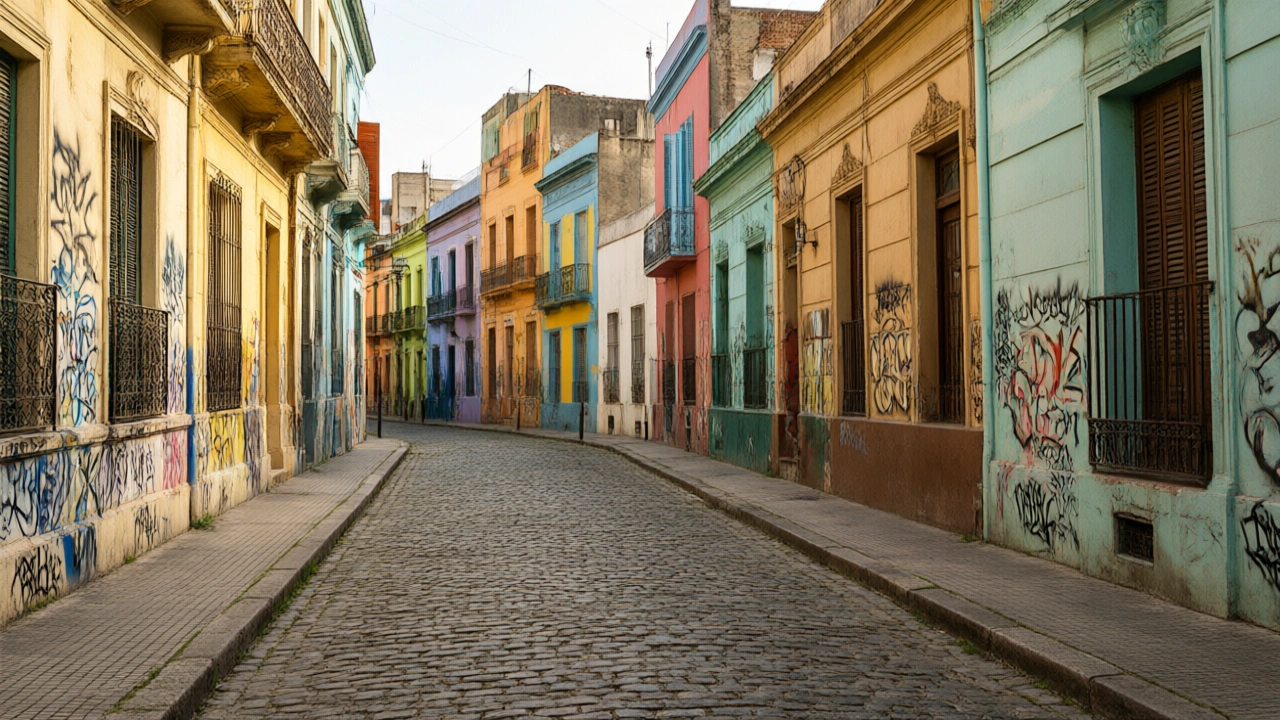
San Telmo rewards people who value texture over polish. It’s cobblestones and colonial facades, weekend ferias and late-night milongas, street art and aging grandeur. It’s also grittier than Palermo, less pristine than Recoleta, and Johnny is explicit about this: “I don’t live in the most dangerous parts.” His safety assessment as a newcomer is positive, but it’s bounded — a tourist-adjacent experience, not a universal claim. If you’re considering San Telmo, the real question is whether you find the edge invigorating or exhausting.
For a broader look at navigating daily life here, including reforms and protests, see our guide on living in Buenos Aires in 2026.
The Tarot Reader Who Sealed the Deal
Outside Chinchin bar at Estados Unidos and Bolívar, Johnny met Astrid La Australa Tarot (@astrid.laaustrala.tarot on Instagram). She spoke perfect English — which was fortunate, because Johnny’s attempt to ask if she did backfired hilariously. He told her “No español” (“You don’t speak Spanish”) when he meant to say he didn’t speak it. Her reply, in flawless English: “I do speak English. But I speak Spanish as well.”
The reading confirmed what he already suspected: Buenos Aires was “the right place at the right time.” Johnny declined to state the price, calling the value “priceless.” He’s not wrong that a well-timed confirmation can feel worth more than any fee, but if you seek out Astrid, expect to negotiate that yourself.
This is the kind of granular, findable detail that signals real local knowledge. Buenos Aires has infrastructure for the spiritually seeking — tarot readers, astrologers, esoteric bookshops, meditation circles — that exists alongside but separate from the steak-and-tango tourist track. Astrid is one specific, English-speaking entry point. She also does online consults, which means you could even test the waters before you arrive.
Disclaimer: Tarot and spiritual services are unregulated; mention of specific practitioners reflects one guest’s experience, not endorsement.
Remote Work Without the “Digital Nomad” Branding
Johnny’s “bread-and-butter job” is playing prisoners online for UK prison service recruitment assessments — a role that went fully remote post-COVID and requires only “a laptop and some Wi-Fi.” It’s weird, specific, and not remotely tech-bro. This opens a useful angle for anyone who assumes remote income means coding, marketing, or consulting.
The infrastructure held up. Johnny reports Wi-Fi across his travels — including Buenos Aires — was “very fast and reliable” as of mid-2026. That said, quality varies by barrio and by building. San Telmo’s older construction can mean thicker walls and spottier signals in some apartments. If your income depends on connectivity, test before you commit to a lease.
For those with location-independent income who want to formalize their stay, Argentina’s Digital Nomad Visa is worth exploring — though Johnny himself entered on standard tourist terms, staying one month, leaving, and returning two months later. Standard 90-day tourist entries apply, but enforcement and renewal policies shift. As of August 2026, confirm current rules at migraciones.gob.ar before planning extended stays or repeat entries. This is not immigration advice.
The Irish-Argentine Thread: Diaspora Romance vs. Reality
Johnny claims Buenos Aires has “the largest Irish diaspora in the non-English-speaking world,” estimating “anything between half a million and a million Irish Argentines” due to 18th-19th century famine migration. Academic sources typically cite 300,000-500,000 Irish immigrants historically, with unknown current descendants — his figure may include broad ancestral claims. Treat it as his personal understanding, not census data.
What’s more telling is what he didn’t find: no active Irish theater scene, despite Irish bars like The Kilkenny in San Nicolás. The diaspora exists historically but isn’t necessarily a living cultural infrastructure you can plug into. This is a caution against romanticizing historical connections — and, potentially, an opportunity. If you’re an Irish creative considering Buenos Aires, the gap Johnny identified could be the opening for cultural entrepreneurship. Or it could just mean you’ll be building community from scratch, same as any other expat.
The World Cup, Mate Resistance, and Gradual Integration
Johnny experienced the 2026 World Cup atmosphere in Buenos Aires — businesses full of fans, “every cafe, every hairdressers” showing matches, local shops setting up tables for viewing. Argentina’s eventual disappointment in the final didn’t diminish the communal intensity. This is Buenos Aires at its most unified: a city that collectively holds its breath for 90 minutes, then exhales into the streets regardless of outcome.
And yet, for all his embrace of the city, Johnny hadn’t tried mate as of our recording — “I don’t know why I’ve been resistant to it.” When he finally did, he found it “very grassy… an acquired taste.” This mirrors many expats’ gradual, sometimes reluctant relationship with deeply embedded cultural practices. You don’t have to love everything immediately. Integration is a slow, uneven process, and resisting mate for months while falling in love with the city anyway is a perfectly valid path.
Practical Next Steps
- If you’re spiritually seeking: Buenos Aires won’t replicate a Sacred Valley retreat, but it offers integration infrastructure — English-speaking practitioners like Astrid, meditation communities, and a culture that doesn’t dismiss the esoteric. Come with an open schedule and let the city reveal its resources.
- If you’re a remote worker: Your income stream can be weirder than you think. A laptop and reliable Wi-Fi are the only non-negotiables. Test connectivity in your specific apartment before committing.
- If you’re Irish (or diaspora-curious): The historical connection is real but thin on the ground. Come for the city, not the heritage — and if you find a way to build the missing Irish theater scene, let me know.
- If you’re choosing a neighborhood: Don’t optimize from a listicle. Walk San Telmo, Palermo, Recoleta, Chacarita, Villa Crespo. Which one feels like it’s already yours? That’s your answer.
Exchange rate note: As of August 2026, the blue dollar gap remains volatile under Milei’s administration. Check dolarhoy.com or Ámbito Financiero for live rates before budgeting. Prices and rates change fast — verify before acting.
FAQ
Can I build a meaningful life in Buenos Aires without knowing Spanish initially?
Yes, but with friction. Johnny’s “No español” misfire — accidentally telling a tarot reader she didn’t speak Spanish when he meant he didn’t — is a perfect microcosm. You’ll survive on English in expat-heavy zones and tourist-facing businesses, but even simple interactions can invert meaning. The city rewards effort; start learning immediately, and expect to be humbled regularly. Many porteños are patient and appreciative of attempts, but the onus is on you to bridge the gap.
Is San Telmo safe for newcomers?
San Telmo occupies a nuanced safety position. Johnny feels “very safe” but explicitly notes he doesn’t live in “the most dangerous parts.” The barrio is heavily touristed during the day, especially around the Sunday feria, which creates a visible security presence. At night, certain blocks away from main drags can feel sketchier. Standard urban awareness applies: don’t flash valuables, know your route home, and pay attention to which streets empty out after dark. Many expats live here without incident; others prefer Palermo’s more consistent nighttime activity. It depends on your comfort with urban edge.
What’s the real cost of living for a remote worker in Buenos Aires in 2026?
Johnny describes Buenos Aires as affordable for remote workers, but gave no specific peso figures in our conversation. As of August 2026, the economic situation under Milei remains volatile — the blue dollar rate fluctuates, and inflation continues to reshape prices monthly. A remote worker earning in USD, EUR, or GBP will find Buenos Aires significantly cheaper than most Western cities, but exact numbers age poorly. Budget in your earning currency, not pesos, and check live rates before committing to long-term rentals. For a deeper dive into the current economic landscape, read our June 2026 economic update.
Does Buenos Aires have an active Irish expat community?
Historically, yes — Argentina absorbed significant Irish immigration during the 19th-century famine era. Johnny estimates 500,000 to 1 million Irish Argentines, though academic sources typically cite lower figures and no official census confirms his range. In practical terms, Johnny found Irish bars like The Kilkenny in San Nicolás but no active Irish theater scene or organized cultural infrastructure for newcomers. The diaspora is more ancestral memory than living community. If you’re seeking an Irish expat network, you may need to build it yourself or look to more general English-speaking expat circles.
Is ayahuasca legal in Argentina, and can I find retreats there?
Ayahuasca’s legal status varies by jurisdiction globally, and this article does not provide legal advice. Johnny’s retreat took place in Peru’s Sacred Valley, not Argentina. If you’re considering ayahuasca in any country, research local laws, verify the safety and reputation of any retreat center, and consult a medical professional — the brew carries significant physical and psychological risks and can interact dangerously with certain medications and conditions. This content describes one individual’s experience and is not a recommendation.
Disclaimer: This article is not legal, immigration, tax, or medical advice. Visa rules, exchange rates, and economic conditions change rapidly — confirm current information with official sources before acting. Ayahuasca and spiritual services discussions reflect individual experiences, not endorsements.
Watch the full conversation with Johnny O’Dowd here: Johnny O’Dowd on the Gringos in Buenos Aires Podcast.